Why Harry Maguire Goal Stood for Man United Despite Clear Handball as Bizarre Rule Explained

Manchester United’s emphatic 5-2 victory over Ipswich Town at Old Trafford on Sunday afternoon will be remembered for Bruno Fernandes’ clinical hat-trick and a much-needed response after their opening-day humiliation against Hull City. Yet the moment that sparked the loudest debate, the most furious protests from the visiting players, and the longest post-match explanations was not one of Fernandes’ three goals. It was the second goal of the afternoon, the strike that put United ahead for the first time, and the one that officially belongs in the record books as a Jacob Greaves own goal.
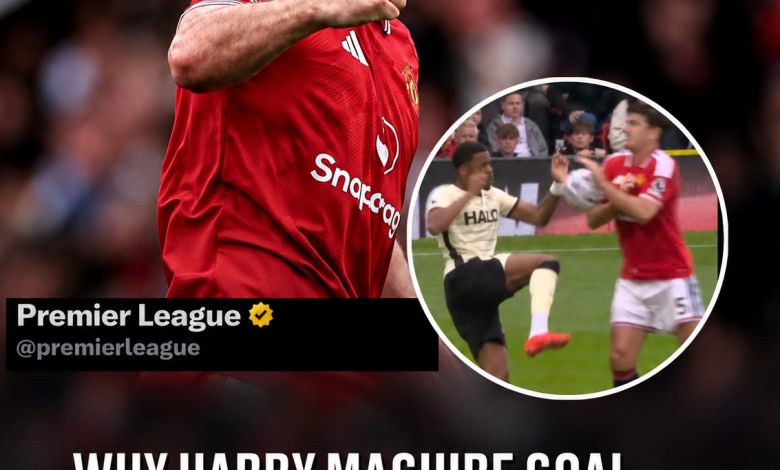
In the 56th minute, with the score locked at 1-1, the ball was cleared out of the Ipswich penalty area. Harry Maguire, positioned just outside the box, moved to control it. Replays from multiple angles showed the ball clearly striking the United defender’s arm before he brought it under control with his feet. Maguire then took a touch, set himself, and drove a low right-footed shot towards goal. The effort was heading wide of the far post. Ipswich centre-back Jacob Greaves, attempting to clear the danger, got a decisive touch that diverted the ball into his own net. Referee Craig Pawson pointed to the centre circle. Old Trafford erupted. Ipswich players surrounded the officials in disbelief. VAR Jarred Gillett reviewed the incident. After a lengthy check, the goal was allowed to stand.
To the casual observer, and to many seasoned supporters, the decision looked wrong. A clear handball in the build-up had led directly to a goal. How could it possibly be given? The answer lies in one of the more nuanced — some would say bizarre — applications of the current handball law.
The critical distinction: Maguire did not score
Under the Laws of the Game as written by the International Football Association Board (IFAB), an accidental handball by an attacking player is only penalised if that same player scores the goal immediately afterwards. The law states that it is an offence if a player scores in the opponents’ goal:
- Directly from their hand or arm, even if accidental
- Immediately after the ball has touched their hand or arm, even if accidental
However, there are specific exemptions. The goal is not disallowed if:
- The goal is not scored immediately after the handball
- The goal is scored by a teammate
- The ball is clearly moving wide of the goal (or away from goal) but is then touched or played by a defending player, resulting in a clear own goal
In this instance, Maguire’s shot was not on target. It was going wide. Greaves’ intervention turned a non-goal into an own goal. Because Maguire was not the immediate goalscorer, the accidental handball that preceded the shot was not punishable. VAR’s communication to the on-field referee was explicit: “It’s an own goal and the accidental handball is not punishable, so we recommend you award the goal.”
The Premier League Match Centre confirmed the same reasoning shortly after the final whistle: the referee’s call of goal was checked and confirmed by VAR, with it deemed that Maguire was not the immediate goalscorer after an accidental handball.
Had Maguire’s effort gone straight into the net without any deflection, the outcome would almost certainly have been different. The goal would have been ruled out and Ipswich would have been awarded a free-kick. Gary Neville, commentating for Sky Sports, immediately grasped the distinction: “If that shot had been on target it wouldn’t have been a goal.” Maguire himself later acknowledged the fine margin. Speaking after the match, he said: “I haven’t seen it back, so I can’t really comment. I know it was tight. It wasn’t handball on purpose. I dragged the shot wide, and I think that’s why it stood. It’s a new rule. We deserved that win and that bit of luck.”
Accidental versus deliberate
A second layer of the decision involved whether the handball itself was accidental or deliberate. VAR judged it accidental. Maguire’s arms were raised in a natural defensive position as he contested the bouncing ball with Ipswich forward Chuba Akpom. There was no clear movement of the arm towards the ball or attempt to control it deliberately with the hand. Under current interpretation, only deliberate handball (or handball that makes the body unnaturally bigger) is automatically penalised in open play. An accidental contact that does not lead to an immediate goal by the same player is allowed to go unpunished.
This combination of factors — accidental contact plus an off-target shot that became an own goal — created a perfect storm of controversy. Ipswich felt robbed. Many neutral observers felt the spirit of the law had been stretched. United, understandably, accepted the decision without complaint and used the momentum to take the game away from their opponents.
Broader context of the handball law
The handball law has undergone several revisions in recent seasons precisely because of the confusion it generates. The move away from purely “ball-to-hand” interpretations towards greater consideration of intent and whether the arm makes the body unnaturally bigger was intended to reduce the number of soft penalties and disallowed goals. Yet situations like Maguire’s still leave supporters baffled. The exemption for own goals after an accidental handball is logical on paper — it prevents a defender’s misfortune from being compounded by a technicality — but it can feel deeply unsatisfactory when the handball has clearly helped the attacking player gain control of the ball in a dangerous area.
Similar incidents are rare but not unique. A comparable case occurred in January 2023 when a Brentford goal against Liverpool was allowed to stand under the same principle. In both instances, the attacking player handled the ball accidentally, shot, and a defender’s touch turned the effort into an own goal. The consistency of the application suggests the officials got the call right according to the current wording of the law, even if the outcome feels counter-intuitive.
Impact on the match and aftermath
The goal proved pivotal. United, who had been level after Fernandes’ first-half equaliser, suddenly led. Five minutes later Greaves committed a foul on Matheus Cunha inside the box, and Fernandes converted the penalty to make it 3-1. The Portuguese midfielder completed his hat-trick in the 68th minute, Bryan Mbeumo added a fifth, and Chuba Akpom’s late consolation for Ipswich was little more than a footnote. What began as a potentially awkward afternoon for Michael Carrick’s side turned into a statement victory.
For Maguire personally, the moment carried extra irony. The England international remains without a goal in 2026. The strike that looked for all the world like his first of the calendar year was officially credited to the opposing defender. He will take the three points and the bit of fortune, but the debate around the decision is unlikely to die down quickly.
In the end, the explanation is straightforward once the full law is applied: Harry Maguire handled the ball, but he did not score the goal. Because his shot was going wide and a defender turned it in, the accidental handball could not be punished. The decision was correct under the rules. Whether those rules produce a result that feels fair remains a question many will continue to ask.