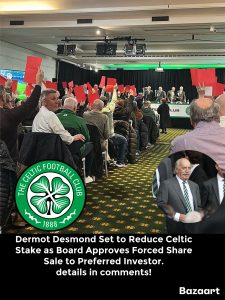
Dermot Desmond Set to Reduce Celtic Stake as Board Approves Forced Share Sale to Preferred Investor
Dermot Desmond is set to relinquish part of his status as Celtic Football Club’s largest shareholder after the club’s board approved a resolution that will compel him to sell a portion of his shareholding to an investor the board believes is better aligned with the club’s long-term strategy.
The Irish billionaire, who has been Celtic’s majority shareholder since 1994 and currently controls approximately 22.8% of the club through his investment vehicle, will be required to offload an undisclosed number of shares under a rarely used clause in the company’s articles of association. The move, confirmed by Celtic PLC in a statement to the London Stock Exchange on Friday afternoon, marks the first time in 30 years that Desmond’s grip on the Parkhead club has been directly challenged from within.
Board’s Rationale: “Strategic Realignment”
In the official statement, Celtic’s board said the decision followed a six-month strategic review aimed at “securing sustainable investment and governance stability” ahead of the club’s 2026/27 European campaign and stadium redevelopment plans.
“The board has unanimously agreed that introducing a new significant shareholder with operational expertise in sports infrastructure and global commercial partnerships is in the best interests of Celtic Football Club,” the statement read. “Mr. Desmond has been asked to divest a portion of his holding to facilitate this transition.”
While the board did not name the preferred investor, multiple sources close to the club told reporters it is a North American consortium with experience in MLS and NBA franchise management. The group is understood to be led by a tech entrepreneur with existing ties to Scottish sport.
Desmond’s office has not yet issued a formal response, but a spokesperson confirmed he is “reviewing the board’s position and taking legal advice.”
The forced sale mechanism stems from Article 31.4 of Celtic’s articles, a provision introduced in 2018 that allows the board to require a shareholder to sell if they are deemed to be “acting contrary to the strategic direction of the company” or if their continued ownership is “materially detrimental to the club’s commercial or sporting interests.”
Until now, the clause had never been invoked. Legal experts say its use will set a precedent in Scottish football governance.
“This is extraordinary,” said Dr. Sarah McLean, a sports governance lecturer at Glasgow Caledonian University. “Shareholder agreements usually protect major investors. For a board to override that requires overwhelming justification and a very high threshold of evidence. It suggests there’s been a serious breakdown in trust.”
Desmond, 75, has long operated as Celtic’s most influential figure despite not being an executive director. He has been credited with stabilizing the club financially in the 1990s and has provided crucial loans and backing during periods of transition. However, tensions have been rising since last summer.
The flashpoint is believed to be Desmond’s opposition to the board’s proposed £80 million redevelopment of Celtic Park’s east stand and his resistance to a new multi-club ownership model that the board sees as vital for competing in Europe. Desmond has publicly favored a more conservative financial approach, prioritizing domestic dominance over aggressive expansion.
We spent as we should, we did as we could, but your approach has left us stagnant in Europe,” one board member reportedly told Desmond at a closed-door meeting in April, according to a source familiar with the discussions.
Celtic shares on the AIM market dropped 7.2% within an hour of the announcement before stabilizing. The Celtic Supporters Trust issued a cautious statement calling for “clarity and transparency.”
Dermot Desmond has been a constant for three decades. If the board believes a change is necessary, they must explain why and what the alternative looks like,” said Trust spokesman Kevin McKenna. “Fans will not accept backroom deals that undermine the club’s independence.”
Meanwhile, several Celtic fan groups have voiced concern that the new investor could push for a diluted fan ownership model or changes to the club’s identity. Others have welcomed the prospect of fresh capital and modernization.
What Happens Next
Under the resolution, Desmond has 60 days to comply with the sale directive. The board has set a minimum price of £3.10 per share, valuing the portion to be sold at approximately £18-22 million, though the final number will depend on how many shares Desmond is required to relinquish.
The buyer must pass the Scottish FA’s fit-and-proper person test and the Premier League’s ownership regulations, even though Celtic play in the Scottish Premiership. The deal also requires 75% shareholder approval at an Extraordinary General Meeting, likely to be called in late June.
Chief Executive Michael Nicholson said the board remains “fully committed to sporting success and maintaining Celtic’s values.” He added: “This is not about removing Dermot’s legacy. It’s about ensuring the next 30 years are as successful as the last.”
Desmond is expected to retain a significant minority stake and a seat on the advisory board even after the sale, preserving his influence but ending his role as the dominant shareholder.
Broader Implications
If completed, the sale would be the most significant ownership shift at Celtic since the Fergus McCann takeover in 1994. It also reflects a growing trend in European football where traditional investor structures are being reshaped by private equity and multi-club groups.
For now, the focus turns to the pitch. Celtic sit five points clear at the top of the Scottish Premiership with four games remaining and are preparing for a Scottish Cup semi-final against Rangers next weekend. But off the pitch, the power struggle at Parkhead has only just begun.