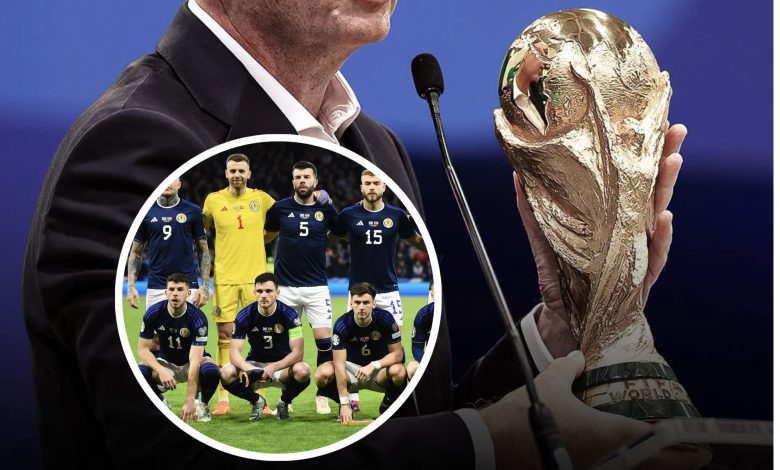
Scotland’s World Cup destiny may have just taken a dramatic turn—and it has nothing to do with what happens on the pitch.
Just hours before Steve Clarke’s men step onto the field against football giants Brazil in their final Group C showdown, FIFA confirmed a tournament-defining rule adjustment that has sent shockwaves across the competition and completely altered the qualification picture for several nations still battling for a place in the knockout rounds.
For weeks, fans have been calculating goal differences, predicting scorelines and trying to work out exactly what Scotland would need to reach the World Cup knockout stage for the first time in their history.
But now? Everything has changed.
The bombshell revolves around FIFA’s newly implemented head-to-head tiebreak system, which now takes priority over goal difference when teams finish level on points. The rule has already created winners and losers throughout the tournament and is proving far more influential than many expected when the World Cup began.
With Scotland entering the final group match on three points after defeating Haiti and narrowly losing to Morocco, the implications are enormous.
Many supporters had assumed goal difference would be the key factor if Scotland finished level on points with another nation. Instead, direct results between tied teams now carry greater weight, meaning every result from earlier in the group suddenly becomes significantly more important.
And that’s not the only twist.
The expanded 48-team World Cup format means that not only the top two teams from each group can progress, but also the eight best third-placed teams across the tournament. That additional safety net has kept Scotland’s hopes alive despite their defeat to Morocco.
Heading into tonight’s clash, Scotland know that even if they fail to finish in the automatic qualification places, there may still be a route into the Round of 32 through the best third-place rankings.
The pressure, however, could not be greater.
Standing in their way is a Brazil side managed by Carlo Ancelotti, with the legendary Neymar reportedly fit and available for selection after injury concerns earlier in the tournament.
For Scotland supporters, the timing of FIFA’s announcement could not be more dramatic.
Social media erupted almost instantly as fans attempted to understand the implications. Some believe the rule improves Scotland’s chances. Others fear it could punish them if results elsewhere do not go their way.
What is certain is that the final Group C picture is now more complicated than ever.
While Scotland battle Brazil in Miami, Morocco will simultaneously face Haiti in Atlanta, meaning every goal in both matches could influence the final standings.
The atmosphere is expected to be electric.
Scotland have already shown they can compete on the world stage, but now they face the ultimate test against one of football’s most decorated nations. A positive result against Brazil would not only shock the tournament—it could completely transform the qualification equation and send Scottish supporters into scenes of celebration rarely witnessed in international football.
The stakes are enormous.
The margins are razor thin.
And thanks to FIFA’s controversial mid-tournament rule emphasis, the path to the knockout stage has become even more unpredictable.
One thing is certain: when the whistle blows tonight, Scotland won’t simply be playing Brazil.
They’ll be fighting history, battling mathematics, and chasing a place in the knockout rounds under a qualification system that has suddenly become the biggest talking point of the entire World Cup.
The dream is still alive.
But after FIFA’s latest move, nobody can say with certainty what happens next.