SEVERAL ARAB & AFRICAN FEDERATIONS PRAISE GIANNI INFANTINO OVER SHOCK WORLD CUP DECISION — DISASTER FOR EUROPEAN COUNTRIES

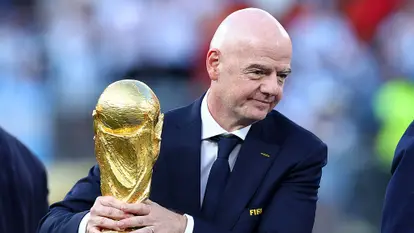
Gianni Infantino has once again placed himself at the centre of a major football debate after opening the door to a potentially historic expansion of the FIFA World Cup — and the idea could have major consequences for European football.
The FIFA president has confirmed that the possibility of increasing the World Cup from its current 48-team format to 64 teams for the 2030 tournament will be examined by FIFA’s relevant committees.
Infantino’s comments came after the 2026 World Cup, which was the first edition to feature 48 nations instead of the traditional 32.
And according to the FIFA president, the results have strengthened the argument that more countries should be given the opportunity to compete on football’s biggest stage.
“Every nation should be allowed to dream of participating in the World Cup,” Infantino said, arguing that the quality of football outside the traditional European and South American powers is continuing to rise.
His argument is particularly powerful when looking at Africa’s performance at the 2026 tournament.
Nine of Africa’s ten representatives reached the knockout stage, compared with only two African teams making the last 16 at the 2022 World Cup.
Infantino highlighted that improvement as evidence that expanding opportunities for nations from less-established football regions can help accelerate their development.
AFRICA COULD BE ONE OF THE BIGGEST WINNERS
The prospect of a 64-team World Cup is naturally attractive to many African football associations.
The 2026 expansion already increased Africa’s representation significantly, giving the continent 10 places at the tournament compared with five at the previous edition.
A further expansion could potentially create even more opportunities for African nations to qualify.
That is one reason Infantino has received strong backing from African football leadership.
CAF’s member associations unanimously agreed in April to support Infantino’s re-election as FIFA president for the 2027–2031 period. CAF has also repeatedly praised his contribution to the development of African football.
CAF president Patrice Motsepe has previously described Infantino as someone who has remained loyal to Africa and supported the continent’s football development.
The expanded World Cup has also given African football a much bigger platform.
Cape Verde qualified for its first-ever World Cup, while several other African teams produced performances that attracted worldwide attention.
For many African federations, therefore, the argument is simple: if more teams are given access to the World Cup, more countries can develop, generate revenue and expose their players to the highest level of international competition.
ARAB FOOTBALL ALSO STANDS TO BENEFIT
The Arab football world has also gained significantly from FIFA’s expansion of the tournament.
Morocco will be one of the principal hosts of the 2030 World Cup alongside Spain and Portugal, while Saudi Arabia is scheduled to host the 2034 edition.
The possibility of 64 nations competing in 2030 could therefore have enormous implications for football across the Arab world and Africa.
However, it is important to stress that there is no confirmed decision yet to make the 2030 World Cup a 64-team tournament.
Infantino has said the proposal will be examined and discussed. FIFA has not formally approved the expansion.
WHY EUROPE COULD BE THE BIG LOSER
While many football associations outside Europe could welcome further expansion, UEFA has already made its position clear.
European football chiefs have previously criticised the idea of increasing the tournament beyond 48 teams.
UEFA president Aleksander Čeferin has described a 64-team World Cup as a bad idea, while AFC president Sheikh Salman bin Ibrahim Al Khalifa has also warned that further expansion could create “chaos”.
That opposition is significant.
Europe currently has 55 FIFA member associations and remains the most powerful football confederation in terms of elite clubs, players and international competitions.
However, the 2026 expansion did not increase Europe’s allocation by anything close to the same proportion as the increases received by Africa and other confederations.
A further expansion could therefore strengthen the representation of countries outside Europe even more.
For European nations, that could mean a smaller share of the tournament relative to the overall number of participating teams.
There are also concerns over the football calendar.
A 64-team tournament could require 128 matches if a conventional four-team group format followed by a 32-team knockout stage were used.
That would be 24 more matches than the 104-game 2026 tournament and could potentially make an already congested international calendar even more demanding.
INFANTINO’S BIGGEST WORLD CUP GAMBLE YET?
The debate is unlikely to disappear anytime soon.
Infantino believes the success of the 48-team tournament has demonstrated that the World Cup can successfully include more nations without sacrificing competitive quality.
Europe, meanwhile, fears that continual expansion could dilute the tournament, overload players and weaken the importance of qualifying.
The political implications are also impossible to ignore.
Every FIFA member association has one vote, meaning smaller nations carry exactly the same voting power as the biggest football countries in the world.
With Infantino seeking another term as FIFA president, support from Africa, Asia, the Arab world and other regions could prove extremely valuable.
For now, 64 teams in 2030 remains an idea under examination rather than an official decision.
But if Infantino gets his way, the World Cup could soon become even bigger — and European football may have to accept that its influence over the world’s biggest tournament is gradually changing.