THE 3-0 FIRST-LEG WIN HID THE REAL PROBLEM!” — KRIS BOYD’S BITTER VERDICT ON CELTIC AFTER SHOCKING CHAMPIONS LEAGUE EXIT SPARKS FIERCE ONLINE DEBATE

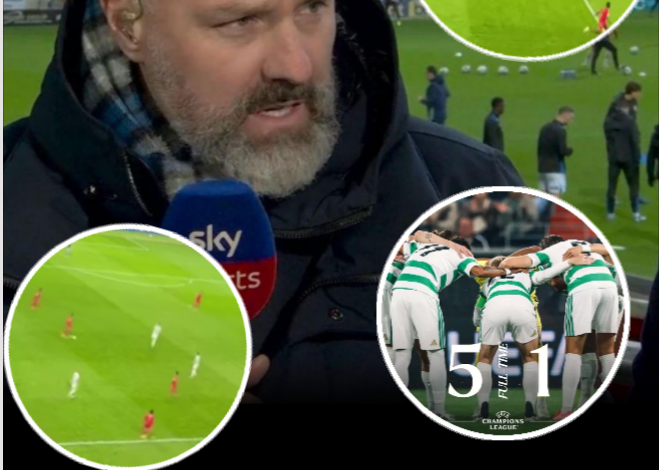

Celtic’s extraordinary Champions League collapse against LASK has left supporters trying to make sense of one of the most painful European nights in recent club history. The Scottish champions travelled to Austria with what appeared to be an almost unassailable advantage after a convincing 3-0 victory in the first leg at Celtic Park. Instead, they somehow surrendered a four-goal aggregate lead and were beaten 5-1 on the night, losing the tie 5-4 after extra time.
That is precisely why the aftermath has become so heated.
For many Celtic supporters, the first-leg result had created a feeling that qualification was almost guaranteed. The performance at Celtic Park had been impressive, with Benjamin Nygren opening the scoring before Camilo Durán struck twice to give Martin O’Neill’s side a commanding advantage. LASK had even threatened during that match, having two goals disallowed, but Celtic ultimately appeared to have enough quality and control to take a huge step towards the Champions League.
But the second leg exposed a completely different side of the team.
Celtic actually made the situation look even safer when captain Callum McGregor scored early in Austria, taking the aggregate advantage to four goals. At that moment, there was seemingly no realistic scenario in which Celtic would fail to progress.
Yet what followed was a collapse that will be discussed for years.
LASK scored through Moses Usor before Robert Ljubicic, Samuel Adeniran and Florian Flecker completed an astonishing comeback. Flecker’s late goal forced extra time, and Adeniran then scored again to put LASK ahead on the night and in the tie. Celtic goalkeeper Viljami Sinisalo even saved a late penalty, but it could not rescue the Scottish side.
Celtic had gone from four goals ahead on aggregate to being eliminated.
That is where the wider debate surrounding the team has exploded.
The argument now is not simply that Celtic had one bad night. The bigger question is whether the 3-0 first-leg victory covered up weaknesses that were already visible.
The warning signs were there.
Even in Glasgow, LASK created opportunities and showed that they were capable of causing Celtic problems. Celtic’s clinical finishing ultimately decided the first leg, but the visitors were not completely overwhelmed for the entire match. That becomes much more significant when viewed alongside what happened in Austria.
The second leg suggested that Celtic struggled badly once the opposition increased the intensity, attacked with greater aggression and forced them to defend for long periods.
Captain McGregor’s post-match assessment only added to the concern. He admitted that Celtic had been passive and said the team had looked scared to go out and win the game. He also apologised to supporters and acknowledged that there was no acceptable explanation for surrendering such a huge advantage.
Those comments have intensified the discussion because they go directly to the mentality issue.
And that is where Kris Boyd’s reported verdict has become such a major talking point among supporters.
The former Rangers striker and Sky Sports pundit has frequently been outspoken when discussing Celtic and Rangers, meaning any strong assessment of Celtic is almost guaranteed to generate a reaction. His central argument in this debate is being interpreted as a warning that the 3-0 first-leg victory may have disguised problems rather than solved them.
For supporters who agree with that assessment, the scoreline at Celtic Park created a false sense of security.
Celtic were clinical.
They were dangerous in attack.
They scored three goals.
They looked comfortable for long periods.
But a good result does not automatically mean every weakness has disappeared.
That distinction has become impossible to ignore after the second leg.
The biggest concern is the manner of the collapse. Losing a close Champions League tie is one thing. Losing after building a four-goal aggregate advantage is something entirely different.
Celtic had multiple opportunities to stop the comeback.
They could have slowed the game down.
They could have controlled possession.
They could have attacked LASK and forced the Austrian side to defend.
They could have responded after conceding.
Instead, the pressure continued to grow until the tie completely changed.
That raises questions about defensive organisation, midfield control, concentration and, perhaps most importantly, mentality.
The first-leg victory allowed those questions to remain in the background.
The second leg dragged them into the spotlight.
For O’Neill, the challenge now goes far beyond explaining one result. He has to rebuild confidence after a defeat that could have a major psychological effect on the squad.
Celtic had been dreaming of returning to the Champions League after missing out at the play-off stage last season. The club had invested heavily in attacking talent during the summer, and recent performances had created optimism that the team could make a serious return to Europe’s elite competition.
Instead, they will have to settle for the Europa League.
There is also a financial dimension to the disappointment. Reports indicate that missing out on the Champions League represents a substantial financial blow compared with the revenues available from the Europa League.
That makes the collapse even more painful.
For Celtic supporters, however, the emotional damage may be even greater than the financial consequences.
Fans believed they were watching a team on its way back to the Champions League.
Then, within the space of one extraordinary evening, that dream disappeared.
The online reaction has therefore become fiercely divided.
Some supporters believe the players simply suffered an inexplicable collapse that should not be used to judge the entire season. Others argue that the defeat proves there were serious weaknesses underneath the positive results.
The latter group will point to the same issue again and again: the first-leg scoreline was not necessarily proof that Celtic were as dominant as the result suggested.
The 3-0 victory was real.
The performance had plenty of positives.
But LASK still created danger.
And when Celtic were placed under sustained pressure in Austria, those weaknesses became impossible to hide.
That is why the phrase surrounding Boyd’s verdict has struck such a nerve.
“The 3-0 first-leg win hid the real problem” is not simply a criticism of one result. It challenges the idea that Celtic’s earlier performance had demonstrated complete control of the tie.
If Celtic are to compete successfully in Europe, they cannot rely solely on moments of individual quality or clinical finishing. They need the ability to manage difficult periods, particularly away from home against teams that refuse to surrender.
That is the lesson supporters will now be demanding O’Neill and his players learn.
The next challenge is to ensure that the LASK collapse does not become the defining moment of the season.
Celtic still have domestic football to play and a Europa League campaign ahead. But the psychological scars from Austria will not disappear immediately.
The players will have to respond.
The manager will have to respond.
And the recruitment strategy may come under renewed scrutiny if weaknesses identified during the collapse remain unresolved.
What looked like a straightforward Champions League qualification has instead become one of the biggest warnings Celtic could have received.
The first leg showed what the team can do when everything works.
The second leg showed what can happen when the opposition takes control and Celtic lose their composure.
That contrast is exactly why the debate around Boyd’s verdict has become so fierce.
Was the 3-0 victory evidence that Celtic were ready for the Champions League?
Or did it temporarily hide problems that eventually came crashing to the surface?
After surrendering a four-goal aggregate advantage and falling 5-4 to LASK, Celtic supporters now have every reason to ask the second question.
And that is what makes this defeat so difficult to forget.
It was not simply a Champions League exit.
It was a collapse that forced Celtic to confront weaknesses they may have preferred not to see.
The first leg offered confidence.
The second leg offered a warning.
Now, Celtic must prove that the warning has been understood.