ONE MISSED PENALTY. ONE BIG DECISION. — RANGERS’ EUROPEAN HEARTBREAK HAS PUT A PLAYER AND DEREK McINNES UNDER THE SPOTLIGHT… AND WHAT HAPPENS NEXT COULD CHANGE EVERYTHING!

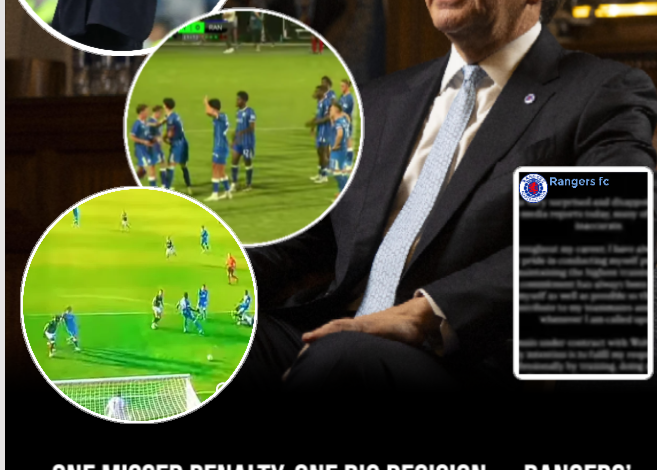
The pain of another European disappointment is still fresh around Ibrox, but this time the frustration is deeper because Rangers had a chance to keep their European hopes alive and ultimately watched the opportunity disappear from the penalty spot.
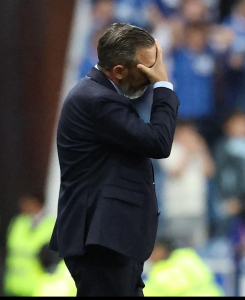
Derek McInnes now finds himself facing one of the most difficult moments of his early Rangers tenure, with the manager under pressure to respond after a night that exposed several problems at once. The defeat was not simply about the final penalty miss. It was about a performance that left supporters questioning whether this Rangers team is ready to compete at the level expected of the club.
Rangers entered the second leg knowing that a place in the UEFA Conference League league phase was still within reach. They had the advantage from the first meeting and understood exactly what was at stake. Yet the night developed into another European nightmare, with Jablonec eventually forcing the tie level on aggregate before winning the shootout.
The final result means Rangers are now out of European competition altogether, a setback that carries sporting, financial and emotional consequences for the club.
And at the centre of the immediate discussion is one player.
Findlay Curtis will understandably feel the disappointment personally after missing his penalty during the shootout. James Penrice also failed to convert, while Lawrence Shankland, Bojan Miovski and Thelo Aasgaard successfully found the net from the spot. Jablonec ultimately held their nerve and secured the victory.
For Curtis, however, the situation should not be reduced to one kick.
Penalty shootouts are brutal because they can turn an entire team’s performance into a single moment for an individual. A player can contribute throughout a match, make important runs, defend when required and continue working until the final whistle, only for one missed penalty to become the image everyone remembers.
That is the danger facing Curtis now.
The attention will naturally focus on the miss because it came at such a decisive moment. Rangers needed composure, and the pressure could hardly have been greater. But McInnes will know that the responsibility for the European exit cannot simply be placed on one player’s shoulders.
The Rangers manager has to look at the bigger picture.
His team had 120 minutes to prevent the match from reaching that stage. The performance had already created concerns before the shootout began, and McInnes himself admitted afterwards that Rangers were “miles short” of the required standard. The manager also accepted responsibility rather than hiding behind excuses.
That admission could prove important.
McInnes now has to decide how he responds to the disappointment and, more importantly, how he handles the players involved.
The temptation after a result like this is to make dramatic changes. Supporters want answers, and understandably so. When a team suffers a painful European elimination, there is immediate pressure for the manager to change personnel, change tactics or send a message to players who failed to deliver.
But this is where McInnes faces a major decision.
Does he protect the player and show confidence in him?
Does he temporarily remove him from the spotlight?
Or does he make changes in the next match because he believes Rangers need a different approach after such a damaging result?
That decision could say a great deal about the manager.
If Curtis is selected again quickly, it could demonstrate that McInnes refuses to allow one missed penalty to define a young player’s contribution. It could also be viewed as an opportunity for the player to respond on the pitch rather than allowing the disappointment to become something that follows him for weeks.
On the other hand, if McInnes decides to make changes, supporters will immediately examine the reasoning behind them.
Either way, the manager’s next selection will attract enormous attention.
That is because the European exit has changed the atmosphere around Rangers. This is no longer simply about an isolated bad night. McInnes’ tenure has already come under scrutiny after a difficult beginning, and the latest defeat adds another layer to those concerns. Rangers previously exited the Europa League qualifiers against Jagiellonia Białystok, meaning this latest result represents their second European elimination in a matter of weeks.
The pressure is therefore understandable.
McInnes arrived with the expectation that he could rebuild Rangers and restore consistency, but European football has provided an early and unforgiving test. The results have not provided the platform many supporters wanted.
There is also the question of confidence.
Football teams can recover quickly from disappointment when they have another important fixture immediately in front of them. The best response is usually made on the pitch. Rangers now need to show that the European failure will not become something that damages their domestic campaign.
That responsibility falls heavily on McInnes.
He must lift the squad, identify the players who can handle the pressure and make sure the disappointment does not turn into a prolonged crisis.
For Curtis, the challenge is even more personal.
The easiest thing would be to dwell on the missed penalty. But players at major clubs eventually learn that football provides another opportunity. The question is whether Curtis can use the disappointment as motivation rather than allowing it to affect his confidence.
The Rangers supporters will also play a role.
Fans can be unforgiving after European exits, particularly when they believe the team has failed to meet the standards expected of the club. Yet there is a difference between demanding improvement from a player and allowing one mistake to completely define him.
Curtis will need support from his teammates and coaching staff if he is to recover quickly.
McInnes therefore has an important balancing act.
He must demand more from his players while ensuring that the dressing room does not become consumed by blame.
That could be one of the biggest tests of his leadership.
The manager cannot change what happened in the shootout. He cannot replay the missed penalty. He cannot give Rangers another opportunity against Jablonec.
What he can control is what happens next.
The next training sessions will be crucial. The next team selection will be examined. The next performance will be judged against the disappointment of this European exit.
And that is why the situation surrounding the player and McInnes is so significant.
One missed penalty may have decided the shootout, but it did not create all of Rangers’ problems.
The manager has to address the performance, the mentality, the attacking threat, the consistency and the ability of his team to deal with pressure. At the same time, he has to decide how much trust to place in the players who experienced the disappointment first-hand.
That is a difficult call.
There is no guarantee that dropping the player would solve anything. There is also no guarantee that immediately selecting him again would produce the desired response.
The answer will depend on what McInnes sees behind the scenes.
Does he believe the player has the mentality to respond?
Does he believe the miss was simply an unfortunate moment?
Does he think the player needs time away from the spotlight?
Or does he believe Rangers require a completely different approach?
Those are the questions now hanging over the manager.
And supporters will be watching closely.
The European dream has disappeared, but Rangers’ season has not.
There is still plenty of football ahead, and that gives McInnes an opportunity to change the mood. A strong response in the next fixture could begin to calm the anger. Another disappointing performance, however, would only increase the pressure surrounding the manager and his squad.
For Curtis, the situation is equally clear.
The missed penalty will be remembered, but it does not have to become the defining moment of his season.
His response can become the bigger story.
That is ultimately what football provides after heartbreak: another opportunity.
McInnes now has to decide who gets that opportunity, who starts, who waits and who must fight his way back into the team.
And after the events of this European night, whatever decision he makes will be watched much more closely than it might have been before.
The penalty has already been taken.
The consequences, however, are only beginning.