DERMOT DESMOND MAKES DECISION ON STEPPING DOWN AS THE CLUB’S CHIEF DECISION-MAKER AFTER RECENT FAN PROTEST AT THE TENNIS COURT

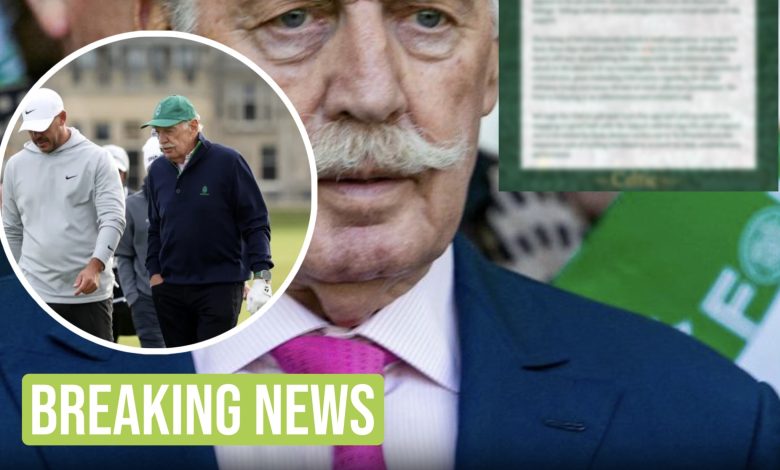
In one of the most astonishing twists in modern Scottish football, Celtic’s shadowy billionaire overlord Dermot Desmond is on the verge of making the ultimate decision — walking away from his role as the club’s chief decision-maker. The catalyst? A humiliating, carefully planned protest in which furious supporters turned a world-famous golf tournament into a chaotic tennis-ball battlefield, forcing the 76-year-old Irish tycoon off the course under heavy security escort.
What began as a quiet Saturday afternoon at the Alfred Dunhill Links Championship on the hallowed Old Course at St Andrews exploded into pure football theatre. As Desmond stood on the 15th green during the pro-am event, a group of Celtic fans — some wearing balaclavas — charged forward and unleashed a barrage of yellow tennis balls. Many of the balls were wrapped in paper bearing Desmond’s face, scored out with thick red crosses. Play was halted. Spectators gasped. Security scrambled. And the man who has quietly controlled Celtic for decades was led away in a scene that has now rocked the foundations of the Parkhead boardroom.
This was no spontaneous outburst. According to Celtic’s own furious statement, the protest was meticulously discussed and planned in advance at a Celtic Fans Collective committee meeting. Minutes allegedly record specific proposals to disrupt the St Andrews event using tennis balls and banners, with Collective funds even earmarked for materials. The fans’ message was brutal and unambiguous: “Dermot Desmond has essentially been allowed to run Celtic Football Club whilst using his wealth to hide from supporters and accountability. Fans took the chance today to send a message that this arrangement cannot continue.”
The club’s response was nuclear. Celtic condemned the action “in the strongest terms,” branded it a premeditated disruption that brought “shame” upon the name of the club, and announced they would no longer recognise the Celtic Fans Collective as a representative body. All engagement with the group has been severed with immediate effect. Anyone found to have been involved in planning, facilitating or participating faces an indefinite ban from Celtic Park. Police Scotland confirmed they are investigating the incident, though no injuries were reported.
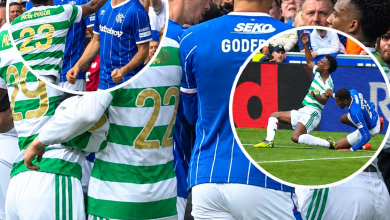
Yet while the club circled the wagons publicly, private conversations are said to be taking a very different tone. Multiple sources close to the situation claim the public humiliation has cut deep. For years Desmond has operated as Celtic’s ultimate power broker — the largest individual shareholder whose influence has shaped transfer strategies, managerial appointments and long-term vision from a distance. He has delivered domestic dominance (14 of the last 15 Scottish titles) but has faced mounting criticism over European underperformance and what many fans see as underwhelming transfer business. Two recent Old Firm defeats to Rangers in the space of a week only poured more fuel on the fire.
Now, after being forced to abandon a golf round under a hail of tennis balls, the question hanging over Celtic Park is simple and seismic: has the time finally come for Dermot Desmond to step back?
Insiders describe a man who values privacy and control above almost everything. The sight of his own supporters turning a prestigious international sporting event into a protest stage — complete with crossed-out images of his face bouncing across the green — is said to have left him “deeply unsettled.” One source familiar with the inner circle suggested Desmond is “seriously weighing whether continued involvement is worth the personal cost.” Another claimed quiet discussions have already begun about a potential reduction in his day-to-day influence, or even a gradual exit from the decision-making core.
The symbolism could not be more powerful. Although the protest took place on a golf course, the tennis balls have become an instant meme and metaphor. Social media is flooded with jokes about “Dermot’s tennis court moment” and captions declaring that “the ball is now firmly in his court.” What was meant as a quiet day of celebrity golf has instead become the most visible challenge to his authority in years.
Fans remain divided. Some cheer the protest as a long-overdue stand against remote ownership and lack of transparency. Others worry that alienating the club’s most powerful shareholder could destabilise the very success Celtic have enjoyed for so long. Pundits are already lining up with dramatic predictions. One former player suggested on radio that “if Desmond walks, everything changes — for better or worse.” Another commentator called it “the day the fans finally forced the king to consider abdicating.”
Celtic currently sit top of the Scottish Premiership under Martin O’Neill, two points clear of Rangers after claiming last season’s title in dramatic fashion. Domestic silverware continues to arrive, yet the European ceiling remains a constant source of frustration. That tension — between domestic hegemony and continental ambition — sits at the heart of the current unrest. Desmond’s critics argue that without greater investment and a more ambitious approach, Celtic will remain stuck in a cycle of domestic comfort and European disappointment. His defenders point to the financial stability and sustained success his presence has underpinned.
Whatever the truth, the tennis-ball protest has shifted the atmosphere. The club’s hardline stance against the Collective shows they will not tolerate direct confrontation. But the very fact that serious people are now discussing the possibility of Desmond stepping down as chief decision-maker proves how effective the protest was in focusing attention where fans wanted it.
As of Monday morning, no official word has come from Desmond himself. The silence only fuels the speculation. Will he dig in and assert even greater control? Will he reduce his stake and hand more visible power to the board? Or will the man who has shaped Celtic from the shadows for decades decide that the personal cost of continued involvement has finally become too high?
One thing is already certain. A group of determined supporters turned the home of golf into a temporary tennis court, and in doing so they may have forced the most powerful figure at Celtic to confront the one decision he has long avoided: whether it is time to walk away.
The next few weeks could redefine the club’s future. The tennis balls have landed. The pressure is building. And Dermot Desmond’s next move — stay or step down — will be the biggest story in Scottish football this season.
Watch this space. History may be about to change at Celtic Park.