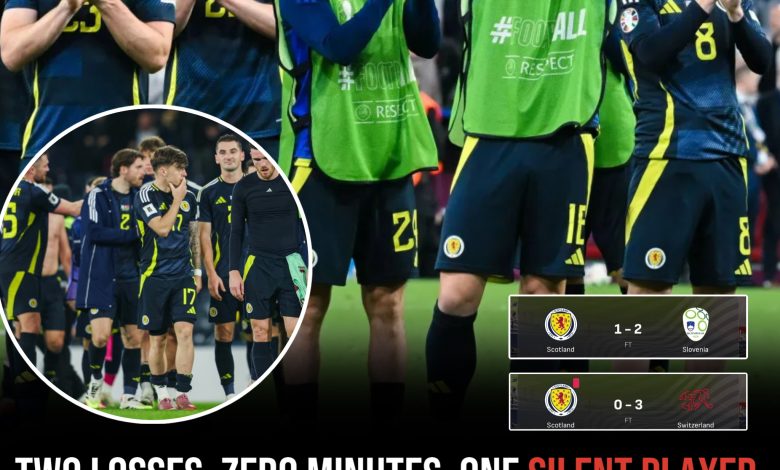
Two defeats have changed the mood around Scotland.
What began as a difficult period has quickly turned into a situation where questions are no longer being asked only about results. Attention has now moved towards the decisions being made around the squad — particularly one player who has watched the latest setbacks from the bench without getting the opportunity to influence either match.
And after remaining largely quiet throughout the situation, the Scotland player has finally spoken.
His comments have immediately added another layer to a story that was already beginning to attract attention.
The player has not launched a direct attack on the manager. He has not publicly questioned the selection. He has not demanded a starting place.
But there was something noticeable about the way he spoke.
It was measured.
It was careful.
And perhaps most importantly, it left the impression that there is considerably more happening behind the scenes than supporters have been able to see.
For Scotland supporters, that is where the story becomes particularly interesting.
TWO DEFEATS, ONE UNCHANGED DECISION
When a team loses once, a manager can usually explain the decision-making process.
When the same team suffers another defeat, however, supporters naturally begin looking for changes.
Different players.
Different combinations.
Different ideas.
That is especially true when there are players on the bench who have been waiting patiently for an opportunity.
Yet despite Scotland suffering back-to-back defeats, the situation surrounding this particular player has not changed.
He has remained on the outside looking in.
That has inevitably raised questions.
Was the decision purely tactical?
Was it about the player’s current form?
Was there a physical consideration?
Or is there another factor that supporters simply do not know about?
Those questions became even louder after the player’s latest comments.

Rather than simply expressing frustration, his words appeared to suggest that he understands there are things supporters cannot see from the outside.
And that has made the situation considerably more intriguing.
HE FINALLY BROKE HIS SILENCE
For a player who has spent so much time waiting, saying nothing would have been the easiest option.
He could have continued training, accepted the manager’s decision and waited for another opportunity.
Instead, he finally offered his side of the story.
There was no explosive confrontation.
There was no public criticism of the coaching staff.
But there was enough in what he said to make supporters wonder whether his absence is connected to something more personal than football.
That distinction matters.
A player being dropped because of tactics is one thing.
A player being left out because of something happening away from the pitch is a completely different situation.
And this is exactly where supporters have started connecting the dots.
The manager’s decision may not necessarily be about ability alone.
POCOGNOLI NOW FACES THE QUESTIONS
Martin O’Neill’s decisions around the Scotland team will inevitably come under greater scrutiny following the consecutive defeats.
Every manager knows that results determine how selection decisions are viewed.
When a team wins, difficult decisions are often described as brave.
When a team loses, those same decisions can suddenly look questionable.
That is the reality of international football.
Pocognoli will therefore know that supporters are going to ask why certain players have not been given opportunities, particularly when the results have not gone Scotland’s way.
The question isn’t necessarily whether the benched player should automatically have started.
It is whether the situation deserved a different approach after the first defeat.
That is where the debate has become more complicated.
Because if the reason behind the player’s continued absence is genuinely personal, then the public may be judging a decision without knowing the full circumstances.
And that could explain why the player’s comments have been so carefully worded.
THERE MAY BE MORE TO THIS THAN FORM
One of the biggest dangers in football discussions is assuming that every omission is about performance.
Sometimes it is.
But sometimes there are factors that supporters never see.
A player may be dealing with circumstances away from football.
There may be conversations between the player and coaching staff that never become public.
There may be concerns about readiness, confidence, workload or something happening within the player’s personal environment.
None of those things can easily be understood simply by looking at a team sheet.
That is why the latest comments have created so much curiosity.
The player appears to understand that supporters want answers.
At the same time, he appears unwilling to reveal everything.
And that combination has made the story even more intriguing.
THE TIMING IS WHAT MAKES IT INTERESTING
Had Scotland won both matches, these comments might have received far less attention.
But the timing is completely different.
Two defeats have arrived.
The player remains on the bench.
Questions are increasing.
And now the player has finally decided to speak.
That sequence is enough to make supporters wonder whether the timing was deliberate.
Did he simply reach the point where remaining silent was no longer possible?
Did the results change his perspective?
Or was there already something being discussed privately before the latest defeat?
Those are questions only the people directly involved can answer.
And for now, there is no definitive public explanation for every part of the situation.
SUPPORTERS ARE LEFT WITH ONE BIG QUESTION
The biggest question is not necessarily whether the player deserves to start.
It is why he has remained unused despite Scotland’s difficulties.
That is the part supporters will continue debating.
Some will argue that the manager has every right to trust his preferred players.
Others will point to the defeats and ask whether it is time to make changes.
Then there will be those who believe the player’s personal circumstances should be respected and that supporters should avoid jumping to conclusions.
All three arguments are understandable.
But the player’s decision to finally speak has guaranteed that the conversation will continue.
And perhaps that is exactly what makes this story different.
He hasn’t revealed everything.
He hasn’t publicly challenged the manager.
He hasn’t demanded answers.
Instead, he has opened the door slightly — just enough for supporters to realise there may be another side to the story.
WHAT HAPPENS NEXT?
The next Scotland squad announcement could therefore carry more significance than usual.
If the player is selected again but remains on the bench, the questions will continue.
If he finally gets his opportunity, supporters will immediately watch his performance under an entirely different level of attention.
And if he is absent altogether, speculation could increase even further.
For Pocognoli, the challenge is straightforward but difficult: find a way to get Scotland back to winning ways while managing the individual situations within his squad.
For the player, the challenge is equally clear.
He has spoken.
Now supporters will be watching to see whether those words are followed by an opportunity on the pitch.
Because after two defeats, one thing is certain.
The silence has ended.
But the real story may only just be beginning.
And until the full circumstances behind the decision become clearer, supporters will continue asking the same question:
Was this really about football — or was there something far more personal behind the decision to keep him on the bench?