“THE REFEREE DECIDED IT BEFORE WE KICKED OFF, THE GAME WAS TAKEN AWAY FROM US “-JOHN EUSTACE FUME AFTER 3-0 DEFEAT TO WEST HAM

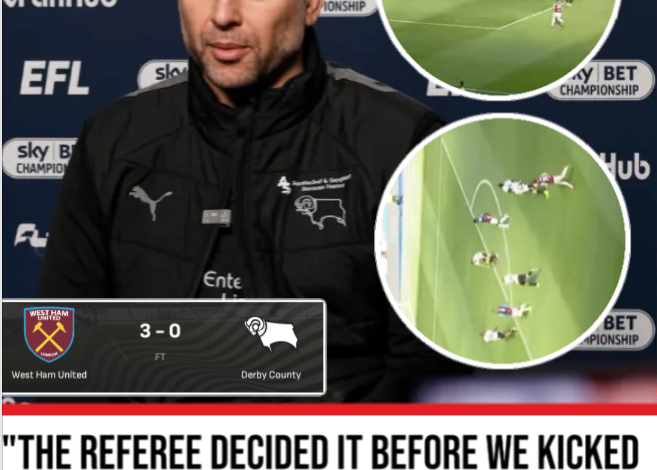

John Eustace stood in the tunnel at the London Stadium, jaw clenched, eyes burning with a mixture of fury and disbelief. His Derby County side had just been dismantled 3-0 by West Ham United in a one-sided affair that left the Championship manager seething. But it wasn’t the scoreline alone that had the former Blackburn and Birmingham boss erupting. It was the officials. And in particular, the man in the middle who, according to Eustace, had made his mind up long before a ball was even kicked.
“The referee decided it before we kicked off. The game was taken away from us,” Eustace spat in his post-match press conference, voice rising with every syllable. “From the first whistle it was clear. Every 50-50 went their way. Every soft foul. Every marginal call. We were fighting an uphill battle against eleven men in claret and blue… and one in black.”
The words landed like a grenade. In an era of carefully measured managerial speak, Eustace’s raw outburst cut through the usual platitudes. Derby had arrived in the capital as underdogs, expected to frustrate and counter, yet found themselves two goals down by the break and three by the hour mark. West Ham’s clinical finishing was undeniable — a header from a set-piece, a deflected strike that wrong-footed the keeper, and a late third that sealed the humiliation. But Eustace refused to accept the result as pure footballing superiority.
He pointed to a first-half penalty shout waved away when a Derby forward tumbled under a challenge inside the box. He highlighted a yellow card shown to one of his midfielders for a challenge that looked no worse than several West Ham ones that went unpunished. He fumed over a second-half free-kick awarded on the edge of the area that led to West Ham’s second goal, calling it “soft as anything.” And he reserved special scorn for what he described as the referee’s “body language” and “attitude” from the opening minutes.
“You could see it,” Eustace continued, gesturing animatedly. “The way he spoke to my players versus theirs. The way he ignored our appeals and jumped on every little thing from our side. It felt like the decision had already been made. We were the Championship side coming to the Premier League club, and the narrative was written. That’s not football. That’s not fair.”
The comments have already sparked debate across social media and the wider game. Supporters of Derby rallied behind their manager, sharing clips of contentious moments and accusing the officials of bias. West Ham fans, predictably, dismissed it as sour grapes from a beaten side. Neutral observers noted that while some decisions looked soft, West Ham had created the clearer chances and looked the sharper, more physical side throughout.
Eustace, never one to shy away from confrontation, doubled down when pressed on whether he risked a charge from the authorities for questioning the officials’ integrity. “I’m not questioning integrity. I’m questioning competence and consistency. There’s a difference. My players put everything into that game. They ran themselves into the ground. And they deserved better than what they got from the man with the whistle. When the big decisions go against you before you’ve even settled, it saps the belief. It takes the game away.”
This is not the first time Eustace has found himself at odds with referees. During his time at Blackburn he was sent off for a touchline altercation. He has previously spoken out about harsh penalties and inconsistent applications of the handball law. His reputation as a straight-talking, no-nonsense coach precedes him, and this latest broadside will only enhance it among those who believe managers should speak their minds.
Yet the wider context of the match cannot be ignored. West Ham, under pressure themselves this season, needed a statement performance and delivered one. Their high press disrupted Derby’s attempts to play out from the back. Their set-piece delivery was sharp. Their clinical edge in front of goal was the difference between a competitive contest and a thrashing. For all Eustace’s fury at the officials, his side failed to register a single shot on target in the first half and looked increasingly disjointed after the second goal went in.
Still, the manager refused to let the narrative settle solely on his team’s shortcomings. “Of course we have to look at ourselves. We weren’t good enough in key moments. We gave away cheap free-kicks. We switched off at the back for the first goal. That’s on us. But when you feel the officials have already decided the outcome, it becomes almost impossible. The energy goes. The belief goes. The game is taken away.”
The fallout is likely to continue. The Football Association rarely takes kindly to managers publicly questioning officials in such direct terms. Eustace may yet face a charge and a fine, just as he has in the past for similar remarks. Whether that deters him remains to be seen. For now, the Derby boss has made his position crystal clear: in his eyes, this was never a fair contest. The referee, he insists, had made his mind up before the teams even walked out of the tunnel.
In the unforgiving world of modern football, where every decision is scrutinised by VAR, slow-motion replays and thousands of armchair experts, managers are expected to accept the verdict with a stiff upper lip. John Eustace is not that type of manager. He saw what he saw, felt what he felt, and said what he said. “The referee decided it before we kicked off. The game was taken away from us.” Whether you agree or not, those words will echo long after the final whistle has faded.