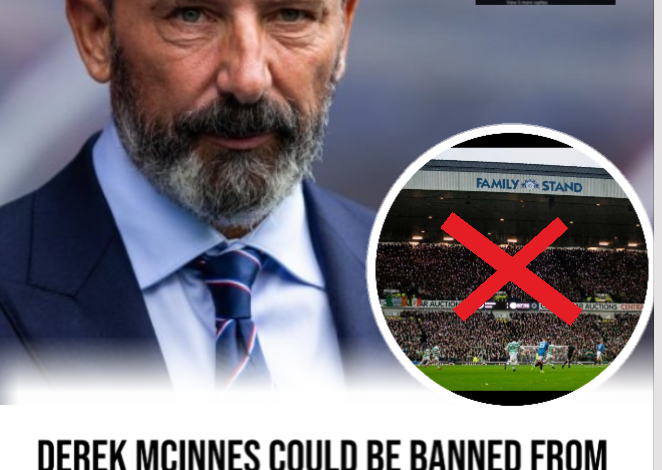

Rangers fans could be facing an unexpected twist surrounding Derek McInnes and the next Old Firm meeting, with the Rangers manager’s comments about a penalty decision involving Celtic having already resulted in disciplinary action from the Scottish FA.
What initially appeared to be another heated reaction to a controversial refereeing decision has developed into a much bigger issue, with the Scottish FA’s disciplinary process now putting McInnes’ availability for future matches under the spotlight.
And with the Old Firm carrying enormous importance for both clubs, the possibility of the Rangers boss being unable to take his place on the touchline is naturally going to attract attention.
The key issue is not simply what happened during the match. It is what McInnes said afterwards and how those comments were assessed under the Scottish FA’s disciplinary rules.
According to the Scottish FA’s official disciplinary records, McInnes was charged under Disciplinary Rule 72 following the Motherwell versus Celtic match on May 13, 2026. That rule covers public criticism of match officials where comments indicate bias or incompetence, as well as remarks that impinge on the character of match officials.
The case eventually went before the Scottish FA disciplinary process, where the charge against McInnes was found proven.
The punishment was significant.
McInnes was handed a four-match suspension, with three matches applying immediately and a fourth match suspended until the end of the 2026/27 season. The suspended match would only become active if McInnes commits another breach of Disciplinary Rule 72 during the relevant period.
That is where the story becomes particularly interesting for Rangers supporters.
McInnes has appealed the decision, and the Scottish FA lists his Appellate Tribunal hearing for Monday, August 31, 2026.
So, while some supporters may already be asking whether the Rangers boss will be banned from the Old Firm, the situation is more complicated than simply saying he will definitely miss the fixture.
The appeal process could become extremely important.
If the existing suspension remains in place and the relevant immediate matches overlap with an Old Firm fixture, McInnes could potentially be forced to watch the match from outside the technical area. However, the exact impact depends on the fixture schedule, the operation of the suspension and what happens with his appeal.
That uncertainty is precisely what makes the situation so intriguing.
For a Rangers manager, being removed from the touchline for an Old Firm encounter would be a major setback. These matches are often decided by small moments, emotional control and tactical adjustments, and having the manager physically present on the touchline can be hugely important.
The Old Firm is also a completely different environment from an ordinary league fixture.
Every decision is scrutinised. Every substitution attracts attention. Every reaction from the dugout becomes part of the conversation. And when the game is played at that level of intensity, the absence of the manager would inevitably become another talking point.
McInnes’ case also highlights just how seriously the Scottish FA treats public comments concerning match officials.
The disciplinary rule involved is not limited to comments made directly to a referee. The Scottish FA states that the rule can apply when remarks are made in interviews, online blogs, social media or other forms of publicity. It can also apply when the Scottish FA becomes aware of the remarks through different means.
That means a manager’s post-match reaction can have consequences long after the final whistle.
For McInnes, the issue began with a match involving Celtic, but the consequences could potentially affect his work with Rangers months later.
That is why the situation has caught the attention of Rangers supporters.
Many fans will naturally want to know exactly what was said and why the comments were considered serious enough to result in a four-match sanction. Others will be more interested in whether the punishment will ultimately remain unchanged following the appeal.
There is also a wider debate surrounding freedom of expression for managers and the protection of match officials.
Managers regularly react emotionally after controversial decisions. Penalty decisions, red cards and late incidents can completely change the outcome of a match, and managers are often expected to explain their frustrations in front of cameras immediately after the final whistle.
However, the Scottish FA’s disciplinary framework makes clear that there are limits to what can be said about officials when comments are considered to cross the line into accusations of bias, incompetence or attacks on character.
The Scottish FA has previously explained that its Judicial Panel system exists to deal with disciplinary matters and that its rules are reviewed and published through the Judicial Panel Protocol.
There is therefore a formal process behind McInnes’ case rather than an informal decision simply being made because of pressure from Celtic or Rangers supporters.
That distinction is important.
Celtic do not decide whether McInnes is suspended. Rangers do not decide whether the punishment should stand. The matter is dealt with through the Scottish FA’s disciplinary structures and, in this case, the appeal process.
The Scottish FA’s records show that McInnes’ original hearing took place on July 22, with the four-match suspension imposed after the charge was proved. His appeal is now scheduled for August 31.
And that date could become an important one for Rangers fans.
Depending on the outcome, the disciplinary situation surrounding McInnes could change. An appeal could alter the position, while an unsuccessful appeal would leave the existing sanction in place.
That is why it would be premature to say that McInnes is definitely banned from the Old Firm.
At this stage, the safer conclusion is that his disciplinary situation has created a genuine question over his availability for future fixtures, including potentially an Old Firm match depending on the fixture sequence and final outcome of the appeal.
For Rangers supporters, however, the headline alone is enough to raise eyebrows.
The manager who is expected to lead the team through one of Scottish football’s biggest fixtures could potentially find himself watching from elsewhere rather than standing in the technical area.
And the irony will not be lost on anyone.
A comment made after a controversial incident involving Celtic has now created a disciplinary story that could potentially follow McInnes into his Rangers tenure.
The next major development will come when the appeal is considered.
Until then, Rangers fans are left with one obvious question:
Could a comment made about a Celtic penalty ultimately cost Derek McInnes his place on the touchline for the Old Firm?
The answer is not yet certain.
But the Scottish FA disciplinary record confirms that the issue is real, the original suspension has already been imposed, and McInnes now has an appeal pending.
For a manager preparing for the intensity of Rangers-Celtic, that is certainly a situation he—and the Rangers supporters—will be watching very closely.