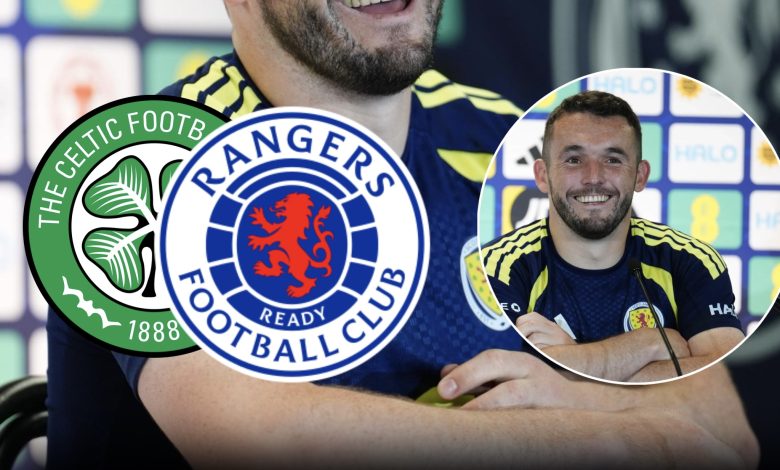
Scottish football has been thrown into fresh turmoil after Aston Villa midfielder and Scotland international John McGinn decided to address the most explosive question in the country: which of Celtic or Rangers is the true biggest club in Scotland.
What many expected to be a carefully worded, diplomatic answer instead turned into one of the most unexpected and polarising comments of the season. McGinn did not crown one side. He did not declare a winner. Instead, he delivered a take so blunt and wide-ranging that it has managed to anger supporters of both clubs in almost equal measure.
The interview itself began in familiar territory. McGinn was asked directly which of the two Glasgow giants he considered the bigger club. Most players in his position would have offered a safe “both are massive” reply and moved on. McGinn, never one to dodge a difficult subject, took a different route.
“I get asked this a lot,” he said. “And every time I hear the question I just think the same thing. The obsession with who is the biggest club in Scotland is one of the most pointless and damaging debates in the game. Both Celtic and Rangers are huge clubs with incredible histories, massive supports, and decades of success. But the constant need to rank them against each other, to claim superiority in every possible category, has become more important to some people than the actual football.”
He continued: “I’ve played in this country, I’ve watched it from the outside, and I’ve seen how much energy gets poured into proving one side is bigger than the other. Attendances, European nights, titles, global reach, social media numbers – it never ends. Meanwhile the rest of Scottish football is left fighting for scraps of attention. That doesn’t feel like a healthy place for the game to be.”
McGinn then went further, making it clear he was not interested in picking a winner. “If you want to talk about who has the stronger European record over the last ten years, the numbers are there. If you want to talk about historical dominance or the size of the support on a matchday, those numbers are there too. Both clubs can make strong cases depending on which measuring stick you choose. The problem is that the measuring stick keeps changing depending on who is winning the argument that week.”
The reaction was immediate and furious from both sides of the Old Firm divide.
Celtic supporters accused McGinn of “sitting on the fence” and “refusing to acknowledge reality.” Many pointed to recent Champions League campaigns and commercial growth as clear evidence of superiority, and took his refusal to endorse that view as a slight. Social media filled with claims that the Hibs-supporting midfielder was “too scared” to tell the truth.
Rangers fans were equally unimpressed. Several prominent accounts described the comments as “typical of someone who doesn’t understand the scale of the club.” Others insisted that McGinn’s reluctance to recognise Rangers’ recovery and sustained challenge in recent seasons showed a lack of respect. The usual accusations of bias quickly followed, despite McGinn having avoided naming either club as the outright biggest.
Neutral observers noted the rarity of the moment: a high-profile Scottish player had managed to irritate both halves of Glasgow without actually choosing a side. One widely shared post summed it up: “McGinn just told the entire Old Firm to grow up and both sets of fans are losing it. Legendary.”
The comments have also sparked a wider conversation about the nature of the rivalry itself. Some former players and pundits have quietly agreed that the constant ranking exercise can become exhausting. Others have defended it as an essential part of what makes the Old Firm unique. The debate, as ever, refuses to die.
McGinn’s timing has only heightened the intensity. With another high-stakes meeting between the two clubs on the horizon and both sides locked in a familiar battle for domestic supremacy, emotions were already running high. His intervention has given every supporter fresh material to argue over, even if the argument is now about whether the argument itself should exist.
Inside the Scotland national team setup the banter is expected to be relentless. Several of McGinn’s international teammates have strong affiliations to one club or the other, and the midfielder’s refusal to pick a lane has left him open to ribbing from every direction. Those who know him suggest he will take the reaction in his stride. He has never been particularly interested in popularity contests.
What makes the episode notable is how evenly the anger has been distributed. In a rivalry defined by binary choices, McGinn refused to play the game on those terms. He did not crown Celtic. He did not crown Rangers. He questioned the entire premise of the contest and, in doing so, managed to leave both sets of fans feeling somehow short-changed.
Scottish football thrives on strong opinions and tribal loyalty. McGinn offered neither in the way supporters expected. Instead he suggested that the energy spent proving which club is bigger might be better spent on the wider health of the game. Whether that message lands or simply becomes the latest piece of ammunition in an endless culture war remains to be seen.
For now the noise continues. Celtic fans continue to insist the numbers prove their case. Rangers fans continue to insist the history and the recovery tell a different story. And John McGinn, hundreds of miles away in the English Premier League, has reminded everyone that sometimes the most explosive thing a player can do is refuse to pick a side at all.
The Old Firm debate will not be settled by one interview. It never is. But McGinn has at least forced a brief moment of reflection on why the question itself generates so much heat. In a rivalry that feeds on certainty, his uncertainty has proven surprisingly combustible.
Both sets of supporters remain convinced their club is the biggest. McGinn simply declined to join the chorus. In the world of Scottish football, that alone was enough to create chaos.